A New Tool for Smart Fishing
The modern fishing industry is rapidly adopting advanced technologies such as drones, artificial intelligence, and computer vision.
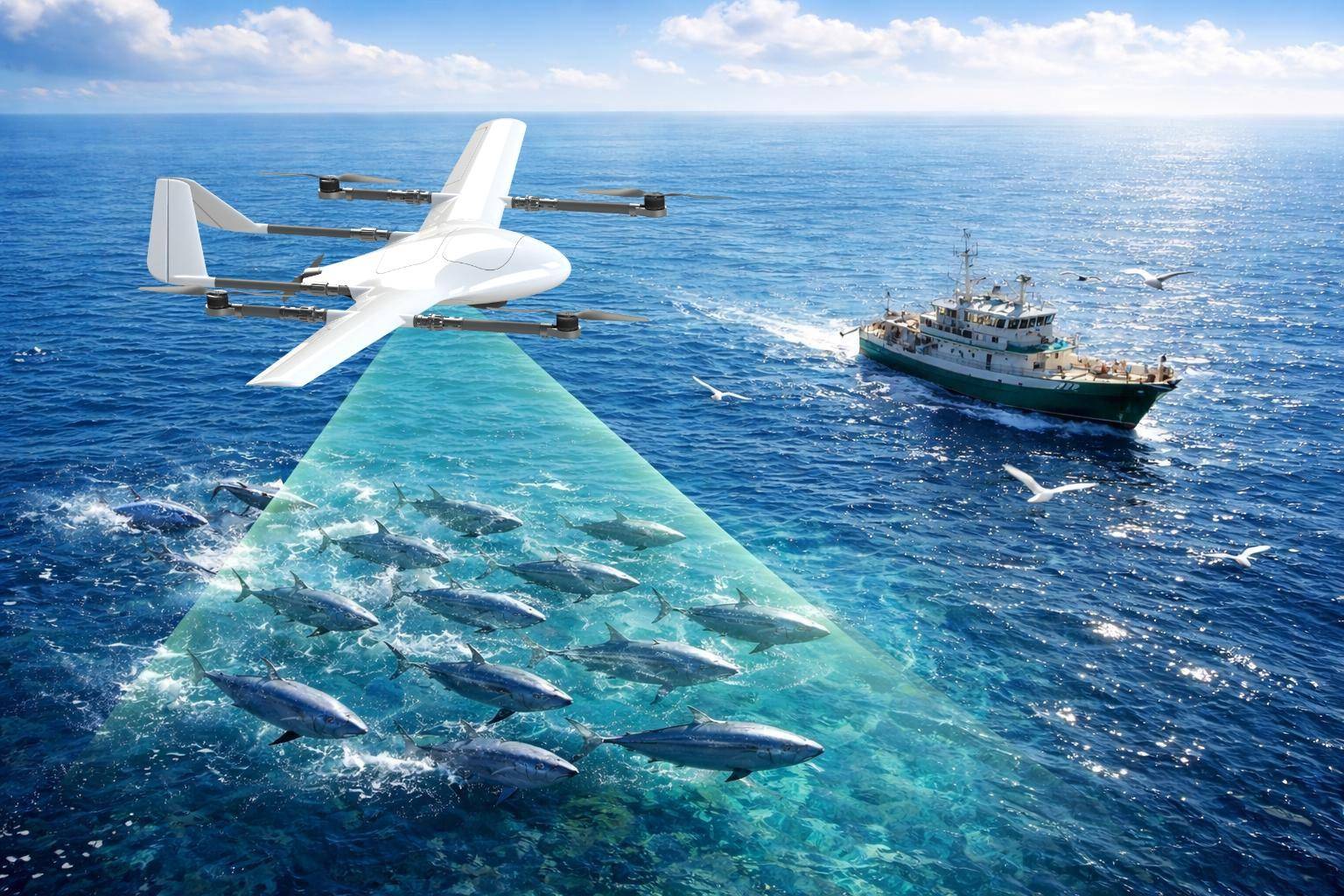
One promising concept is combining the long-range capabilities of the GeoHawk eVTOL UAV developed by Inspiring Sky with specialized AI software capable of detecting fish schools from the air. Such a system could transform how fishermen locate valuable species like tuna and other pelagic fish.
The GeoHawk is a next-generation unmanned aerial vehicle designed for long-distance missions and advanced aerial data collection. Its capabilities include long endurance, autonomous flight, and the ability to carry different sensors and cameras depending on the mission.
Key features include:
• Flight time up to 150 minutes
• Range up to 195 km
• Cruising speeds around 90 km/h
• High-resolution imaging sensors and stabilized gimbals
• Autonomous mission planning and navigation
These capabilities make the platform suitable for tasks such as aerial surveillance, mapping, environmental monitoring, and infrastructure inspection.
Because of its endurance and large coverage area, the drone can scan thousands of hectares during a single flight, making it particularly useful for monitoring large ocean zones.
Integrating AI for Fish Detection
Companies are developing AI-driven drone technologies specifically for the fishing industry. Their goal is to combine drones and AI to locate high-value species such as tuna, improving efficiency and sustainability in commercial fishing.
In such systems, drones collect aerial imagery of the ocean surface while AI algorithms analyze patterns indicating fish presence—such as water movement, bird activity, or the visual signature of fish schools. The processed data can then guide fishing vessels directly to productive areas.
How GeoHawk Could Help Fishermen
By integrating AI software similar, the GeoHawk platform could serve as an intelligent aerial scout for fishing fleets.
Possible workflow:
1. Drone deployment – GeoHawk launches from a vessel or coastal station and flies autonomously over large ocean areas.
2. Aerial scanning – High-resolution cameras capture continuous video and images of the water surface.
3. AI analysis – Computer vision algorithms analyze the footage to detect fish schools such as tuna.
4. Real-time alerts – When fish are detected, coordinates are sent directly to fishermen or fishing vessels.
5. Data mapping – The system generates maps of fish locations and movement patterns.
Because the drone can remain airborne for extended periods and cover large distances, it can monitor wide fishing zones much faster than traditional scouting methods.
Benefits for the Fishing Industry
Combining GeoHawk eVTOL drones and AI fish-detection software could bring several major advantages:
1. Faster Fish Location – Instead of searching blindly, fishermen can navigate directly to areas where fish schools are detected.
2. Reduced Fuel Costs – By minimizing unnecessary vessel movement, fleets can significantly reduce fuel consumption.
3. Increased Catch Efficiency – AI detection can identify high-value species such as tuna more accurately.
4. Sustainable Fishing – Better monitoring of fish populations helps avoid overfishing and improves fisheries management.
5. Large-Area Ocean Monitoring – Long-range drones can monitor ocean regions that would otherwise require many vessels.
The Future of AI-Assisted Fishing
The integration of AI, drones, and advanced sensors is shaping the future of the fishing industry. Autonomous aerial systems like GeoHawk could soon become standard tools for commercial fleets, helping them fish more efficiently while supporting sustainable ocean management.
As AI models improve and more data becomes available, systems capable of detecting fish species from the air will become increasingly accurate and valuable for both commercial fishermen and marine researchers.
In summary:
A system combining the GeoHawk eVTOL drone and AI fish-detection software could revolutionize how fishermen locate species such as tuna, providing faster scouting, lower operational costs, and smarter, more sustainable fishing operations.